Friday, June 29, 2007

Tahoe Quarterly : Summer 2007

The new issue of the Tahoe Quarterly hit the stores today and can be found in retail shops around the North Lake Tahoe, South Lake Tahoe, Truckee, Reno and Northern California area.

I ran into author Robert Frohlich at Spindleshanks restaurant, Tahoe Vista, last year, who I teamed up with years ago when I was the photographer at The Tahoe World newspaper in Tahoe City, and we caught with each others lives. When his editor at the Tahoe Quarterly suggested a piece about residential water features he recalled my unique business and wanted to interview me and learn more about saltwater aquariums.


Here is the portion of the article that pertains to me and Sierra Saltwater Systems.


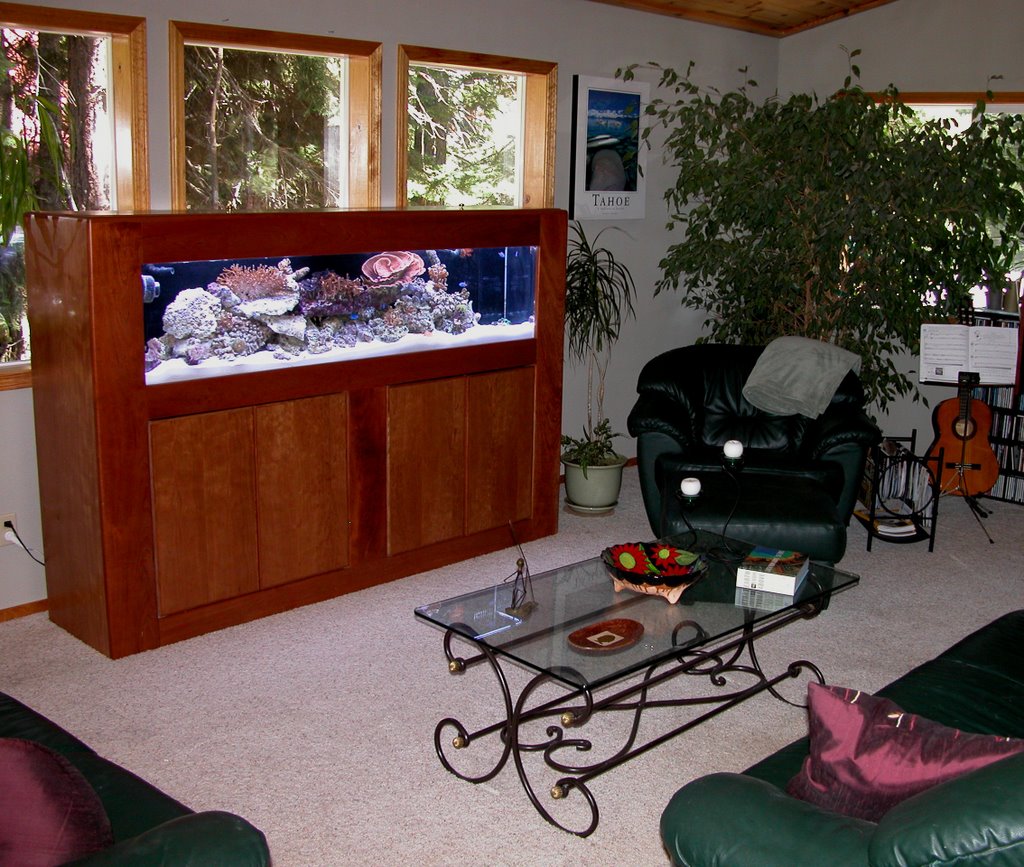
This is a photo (by Vance Fox, courtesy of Genesis Systems) of Tim & Tracy's 650 gallon artificial/live reef tank in Arrowcreek, Reno, Nevada. The system was designed and installed by Genesis Systems. Currently the aquariun houses an Emperor Angel, Mimic Tang, Naso Tang, Powder Blue Tang, four Black & White Heniochus Butterfly fish, five tank raised Bangaii Cardinalfish, tank raised Fridmani Pseudochromis, White Stripe Maroon Clownfish, Sailfin Algae Blenny, Flame Angelfish, Orange Diamond Goby, twelve Green Chromis, Niger Triggerfish, a Solarensis Wrasse and that's just the fish!


I understand that these photos are much too small to read, but if you click on them, you can read the complete article in a full page.

Monday, May 28, 2007

540G Cardboard Creation

It sure is nice when a customer can not only tell me what their vision of an aquarium in their home could be, but can show me. One of my current customers Kevin of Truckee recently purchased a new home in the Davis Lake area of Portola. To show me exactly what he was envisioning in his home he spent some time building this cardboard mock up. His new aquarium will contain 72L"x36W"x48T" of water volume, plus a ten inch overflow box, which will total 538 gallons.

Originally planned as an eight foot "island" aquarium, Kevin and his wife Linda opted for the six foot "peninsula" tank, which puts one side up against the wall and acts as a room divider. The filtration work will be completed by Chris Wirth of Blue Planet Waterworks of Vacaville, CA.

Circulation:
-System will have 2 main pumps.
-One pump will draw from the filtration sump and return through the rockwork in the tank at many angles to eliminate any dead spots in the live rock. With Chris' ingenuity and skills much of the flow will be returned to the aquarium through artificially made "live" rock.
-The second pump will draw from the tanks overflow box and return via an Oceansmotions 4Way valve and 4 Omni flex fully adjustable nozzles coming into the top of the tank. This will keep the tank thoroughly mixed, and avoid detritus settling on the bottom.

Filtration:
-Overflow weir screen will catch any large particles and keep any animals from getting into the pumps or filtration.
-Sump tank to accommodate filtration equipment and automation sensors
-Large protein skimmer with needle wheel air injection (extremely energy efficient), adjustable output, and automatic washdown system
-Refugium to hold live rock and macroalgae (Refugium lighting included) for nutrient scrubbing
-Deareation baffles and pump intake strainer to prevent microbubbles from being passed to the tank.
-Phosphate reactor for algae control
-Calcium reactor for trace element addition

All Blue Planet Waterworks equipment is built to last in the severe environments of a commercial setting. Plastic construction for corrosion proofing is used wherever possible without sacrificing strength. All electrical components utilize liquid-tight or drip proof connections if applicable. All piping shall be labeled and safely supported. All installations are performed with the aquarist and ease of service in mind. Chris builds all systems like he would build his own, and stands behind his work.

Saturday, March 24, 2007

Pomacanthus imperator

Tim & Tracy's Emperor Angelfish. In this magnificent fish there is an incredible color difference between the juvenile and adult specimens. Juveniles of this species have white concentric rings on a dark blue body. Adults have alternating blue and yellowish green lines on the body, a yellow tail a black eye mask and a black band around the pectoral fins. Transforming individuals (sometimes referred to as "teenagers", or "changing") are occasionally seen in the aquarium trade as well. Provide this species with plenty of unencumbered swimming rooms as well as several suitable places to take shelter when threatened. Do not keep juveniles together, or with any other juveniles of this genus that are similar in general color.

Sunday, March 18, 2007

Purple Fungia

One of the easier to maintain hard corals, Purple Fungia is one of the harder to find color forms. Fungia can thrive in a wide range of conditions. Acclimates best in low water flow and indirect lighting, they can adapt to a wide variety of conditions. Best placed on sand bottoms, rather than on rocks, as the tissue is easily damaged by rubbing against rocks. Fungia is nearly identical to the plate coral, but without tentacles.

Wednesday, March 14, 2007

Hippocampus kuda

Hippocampus Kuda is huge by the standard of the most commonly seen seahorses. This incredible animal is tank bred and raised, and will reach a maximum size of approximately 12 inches tall when full grown. It is very important to provide a tank that is not only tall enough but also wide enough to provide enough space for the seahorse to move around comfortably. A minimum tank size of 55 gallons is recommended for the Kuda seahorses, for up to two. Seahorses are slow moving and peaceful animals that should only be kept with others of their own kind or with other peaceful animals. Tank mates such as Pipefish are ideal, but faster moving fish such as tangs and angels should be avoided. Some type of branchy decoration should be provided in the tank for the seahorse to latch on to with its tail so that it can be comfortable. These tank raised Kuda seahorses are used to feeding on frozen Mysis shrimp as well as some brine shrimp. Brine shrimp should be considered a treat, whereas the Mysis shrimp should be considered the daily food.

Saturday, March 03, 2007

Book of Coral Propagation, Vol II

The bible has images! Anthony Calfo's much referred to Book of Coral Propagation is in the process of being re-published and is now available for pre-order through his website www.readingtrees.com .

Anthony is not shy about sharing his knowledge through his experience in the propagation business, which is invaluable. His writing style is easy to read and enjoyable.

I recommend this book to any of my clients who are not afraid to get their hands wet, use a dremel tool or Xacto knife, a little super glue or fishing line and passing on a bit of their reef.

I recently pre-ordered the book through his website (he makes a bit more money if ordered through his website, rather than Amazon or the larger online aquarium suppliers) and he sent me this nice reply.

"Cheers Robert,

Thank you for your book pre-order and your continued support, my friend. I remember back in 2001 that you were one of the first folks to pre-order the first edition of this book!

I look forward to sharing this new edition with you very soon :)

As always, I pray that you enjoy the read and find great merit in the work.

With kind regards,

Anthony Calfo"

Tuesday, December 19, 2006

Happy Holidays & 2006 Wrap-Up

As is seen with the lack of blog updates, work has increased the past couple of months due to the addition of 13 new clients in the year 2006. I look forward to a great 2007 maintaining and improving all of my clients aquariums. Thank you all!

edit, 12/31/06: Added an additional client, Jerry, Susanne and Family of Incline Village, NV, right before Christmas. I will be creating a 180 gallon reef aquarium in their living room with a LifeReef protein skimmer, sump, refugium, a My Reef Creations calcium reactor, IceCap 3 X 250 watt metal halide lighting with Ushio 10K bulbs, Fishbowl Innovations Moonlights.

Sunday, August 13, 2006

Favites: Moon Coral (WYSIWYG)

I have yet to do a "what you see, is what you get" type of livestock availability list on my blog, but some day I may. I was speaking to a client last week about an available space in her aquarium and she was thinking about a trachyphylliidae, open brain coral. I happened to have a very healthy moon coral, commonly called a closed brain coral, in stock for the past couple of weeks and with an email and a copy of these of photos, the piece was sold.

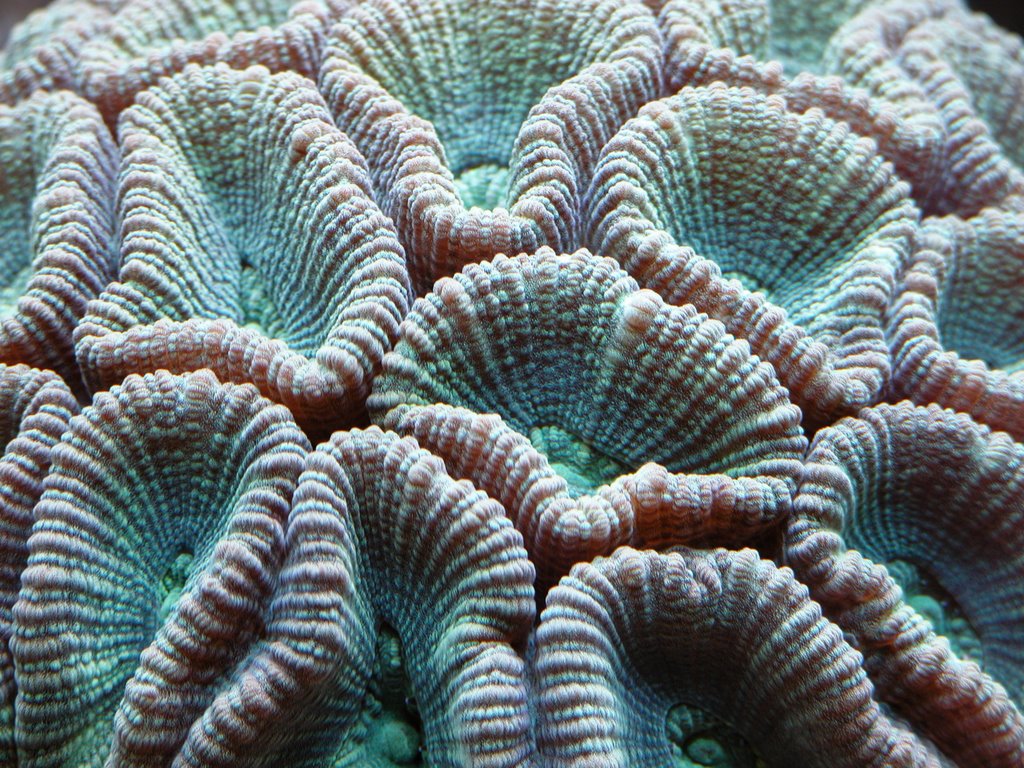
Moon corals, of the favite family, are some of the most common corals in the world. They are typically massive, domed or rounded shaped. Favites are often hardy corals and very well suited for captive care in a reef aquarium, tolerating a wide variety of lighting and flow conditions. Feeding tentacles emerge at night, the flesh typically remains expanded during the day, as in the photo above.

This coral is about 4 inches in diameter and 2 inches in height.

Thursday, August 10, 2006

C...the Journal of Aquatic Science, Travel and Adventure

For a man who spends endless hours at his computer conversing with literally thousands of hobbyists it's impressive he's able to find time to write and manage a new quarterly publication, C...the Journal of Aquatic Science, Travel and Adventure. Anthony's expertise can be found at Team Marine Depot's "Marine Systems and Husbandry" forum, Reef Frontiers "Reef Corals with Anthony Calfo" and his home pages at Wet Web Media and Anthony Calfo's Reading Trees.

Here's a quote from Anthony on the Marine Depot forum: "It's been a busy year as usual, but a blessing to have good work! I am very proud to announce the release of my latest project: C . . . the Journal of Aquatic Science Travel and Adventure. The image work is stunning and aimed to impress as well as educate... the construction quality of the magazine itself is of the highest - it's the same or better cover stock and body pages than your favorite perfect bound books! This journal is printed on 100# gloss laminated stock with thick 80# pages to hold all the ink from those beautiful pictures!"

If you are unfamiliar with the work of Anthony Calfo, the Book of Coral Propagation; Volume 1 (Volume 2 is in production) and Reef Invertebrates: Selection, Care and compatibility are available at his Reading Trees website.

Anthony has always been a huge supporter of local reef clubs including the Marine Aquarist Roundtable of Sacramento and the Western Marine Conference. This weekend he will be at the Southern California Marine Aquarium Society's "Reef-a-palooza" speaking on Black-Body Radiation, Lighting Technologies and their Spectrums. For a gentleman from Pennsylvania, he travels the world sharing his knowledge monthly.

If you are a fellow admirer of the sea, this journal is for you. If you are a client of mine, you may just start seeing this publication in your hands soon.

Thursday, July 27, 2006

Catalina Diving & Snorkeling

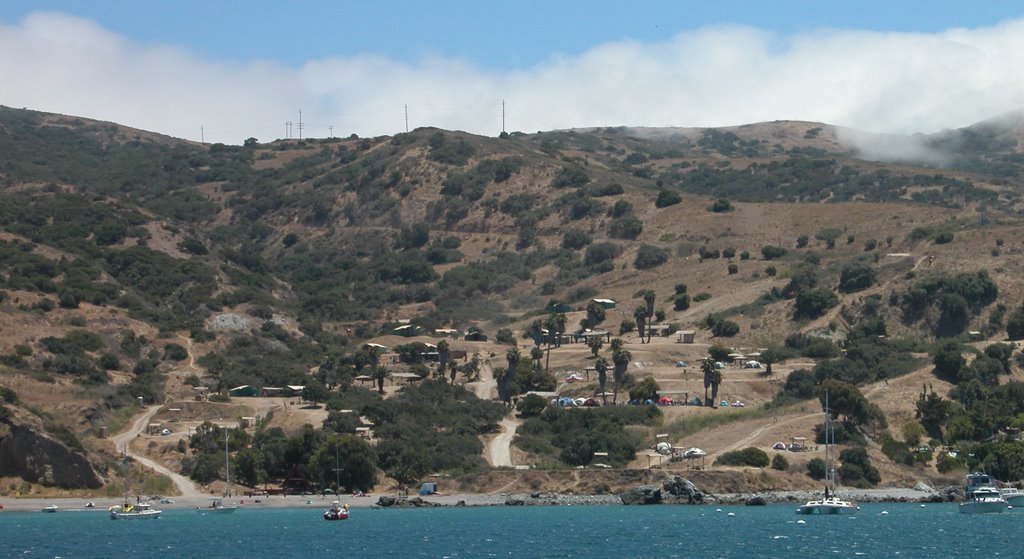
Two Harbors Campground An hour ferry ride from San Pedro to Two Harbors on Catalina Island brought my family to California paradise. Madison was on the island to attend a week long marine biology camp with Mountain and Sea. Jennifer and I spent three nights camping and two nights in Avalon. There are two main developed areas of Catalina Island, Avalon and Two Harbors. Avalon consists of two Safeways, dozens of hotels and restaurants, $40 dollar an hour electric golf cart rentals, Cold Stone Creamery and glass bottom boat rides. Two Harbors has a campground, a restaurant, bar and snack bar, dive shop/recreation rental business and twenty-five cent showers. The campground sits on a bluff overlooking the Pacific Ocean at Catalina's Isthmus, just outside of the village of Two Harbors. The campground features 42 individual sites.

We were fortunate to have a fantastic campsite (#25) over looking the Pacific, looking back towards Los Angeles. Firewood was delivered daily to our site by the wonderful rangers at the campground. (Camping here would be very difficult without their tremendous help delivering necessities and all of our gear to and from the ferry.)

Snorkeling Two Harbors Unfortunately there are no dive operations in Two Harbors Monday-Wednesday, so we spent a lot of time snorkeling the area. Still a ton of sealife to see. A short kayak from Two Harbors brought us to the USC Marine Preserve at Big Fisherman's Point. The preserve had the most sea life to see of all the locations visited on the island. I think the animals knew that they were not going to be threatened. In addition to all the Garibaldi, Opaleye's and Kelp Bass, we were fortunate to see Thornback Rays, Shovelnose Guitarfish and Leopard Sharks. The only bad thing about the area was the difficult kayak into the head winds back to Two Harbors. Other great snorkel spots in the Two Harbors area include the Isthmus Cove, 4th of July Cove and Little Fisherman's Cove.


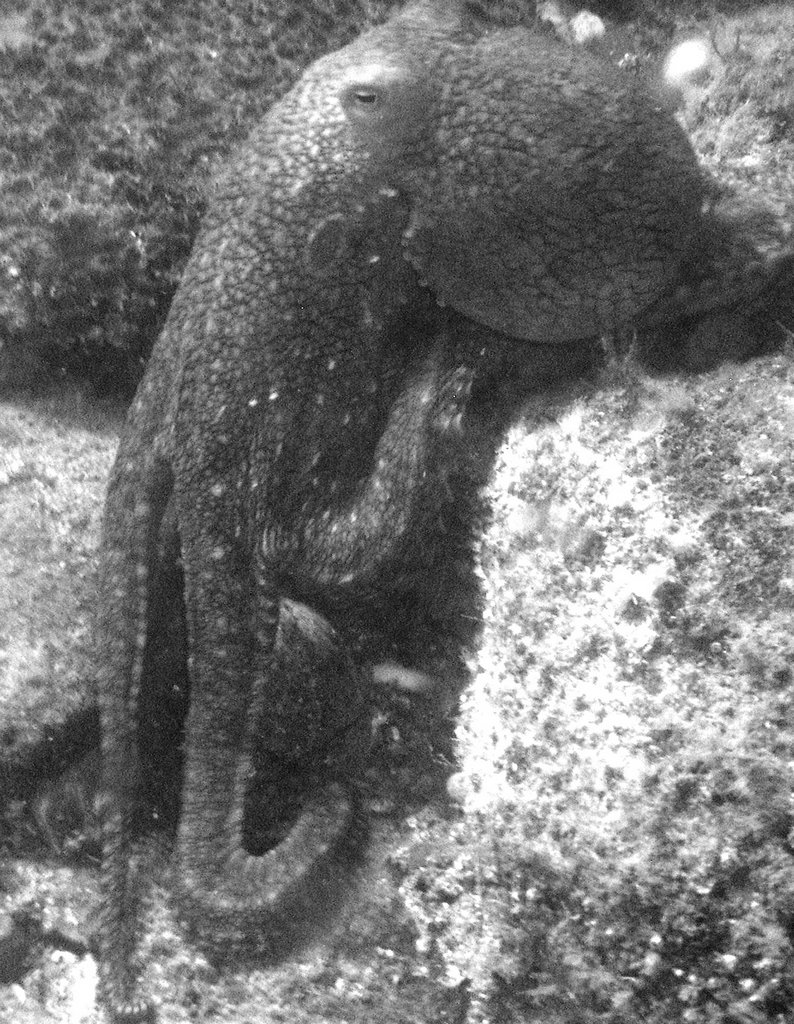
Octopus The octopus is the most intelligent of all the invertebrates. It is said that the octopus has the intelligence of a house cat, but I wouldn't want to insult the octopus. Similar to a rodent, it has the ability to travel through very small spaces and with keeping one in an aquarium, it must be totally sealed or the animal will escape. I transferred this photo to black and white simply because the octopus has the ability to camouflage to its surroundings, I thought the images contrast looked nicer in B&W. Octopus are fascinating creatures with which to interact underwater. Although close, intimate observation is an experience not to be missed, these are delicate creatures that can be easily damaged even to the point of death if grabbed. Although shy, they are quite curious, almost bold if they do not feel threatened and human interaction is not difficult if approached slowly. If threatened the octopus will ink the water in hope to dash away when its predator is lost in the cloud.

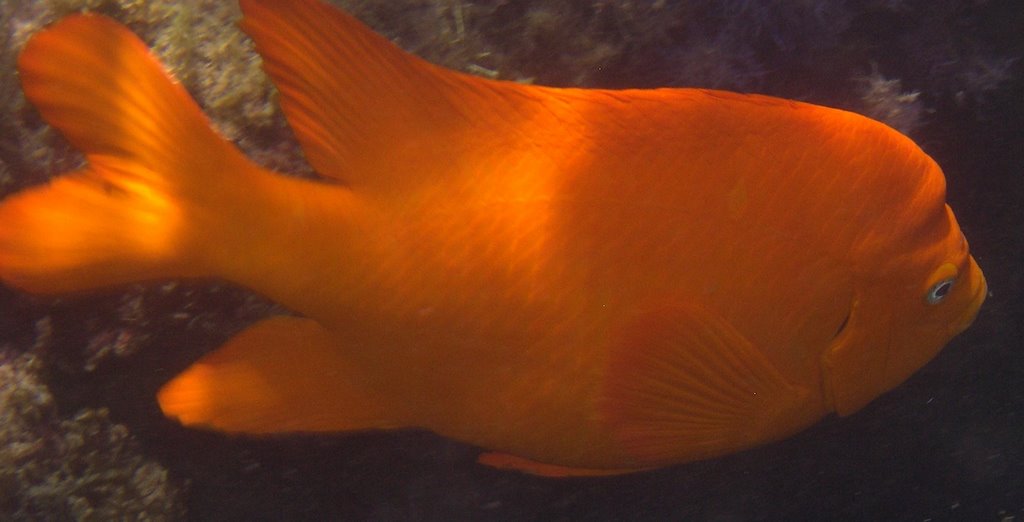
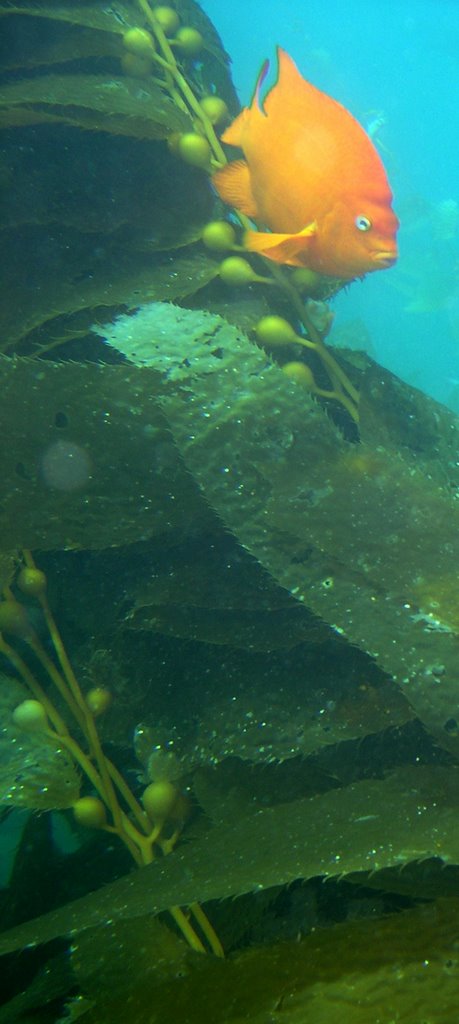
Adult Garibaldi The Garibaldi or Garibaldi damselfish (Hypsypops rubicundus) is a fish of the damselfish family that is native to the northern subtropical parts of the Pacific Ocean, ranging from Monterey Bay to Guadalupe Island, Baja California.Garibaldis are renowned for their brilliant orange color and grow up to 14 inches in length. They live at depths of up to 100 feet, usually in association with reefs and typically over rocky sea-bottoms. They feed mainly on invertebrates that they remove from the rocks. Adult Garibaldi maintain a home territory. The Garibaldi is the official "marine fish" of the state of California and has a protected status in California coastal waters. Juveniles bear electric blue spots to keep the highly territorial adults from constantly harassing them.

Opaleye's Opaleye primarily eat marine algae including feather boa kelp, giant kelp, sea lettuce, coralline algae, but also small tube dwelling worms, and red crabs. They form dense schools in shallower water where spawning takes place. The juveniles form schools of up to two dozen individuals.

Catalina Divers Supply Catalina Divers Supply is the oldest operating dive shop in the city of Avalon, opening in 1957. They offer boat diving from the Avalon Pier and shore dives from Avalon Underwater Park at Casino Point. I did two boat dives with Catalina Divers Supply. The Rock Quarry provided views of Giant Bat Rays, Garibaldi's, Catalina Goby's, Gorgonians, Eels, various Starfish, Sea Cucumbers, Treefish, Rockfish and Spiny Urchin. The second dive was at Alligator Rock/Italian Gardens. The highlight of this dive was the Giant Sea Bass. Giant Sea Bass were once a relatively common inhabitant of Southern California waters. Beginning in the late 1800's, the species supported both a commercial fishery taking hundreds of thousands of pounds annually, and a sport fishery that also landed hundreds of fish each year. Ron, Catalina Diver Supply's divemaster, called exactly where two of these bass were located from the boat. The two bass, well over six feet long and over 400 pounds, were gentle and calm to the divers observations. Also seen at this location in addition to the previous dive were Sea Hare's, Tube Anemones and Kelp Clingfish.

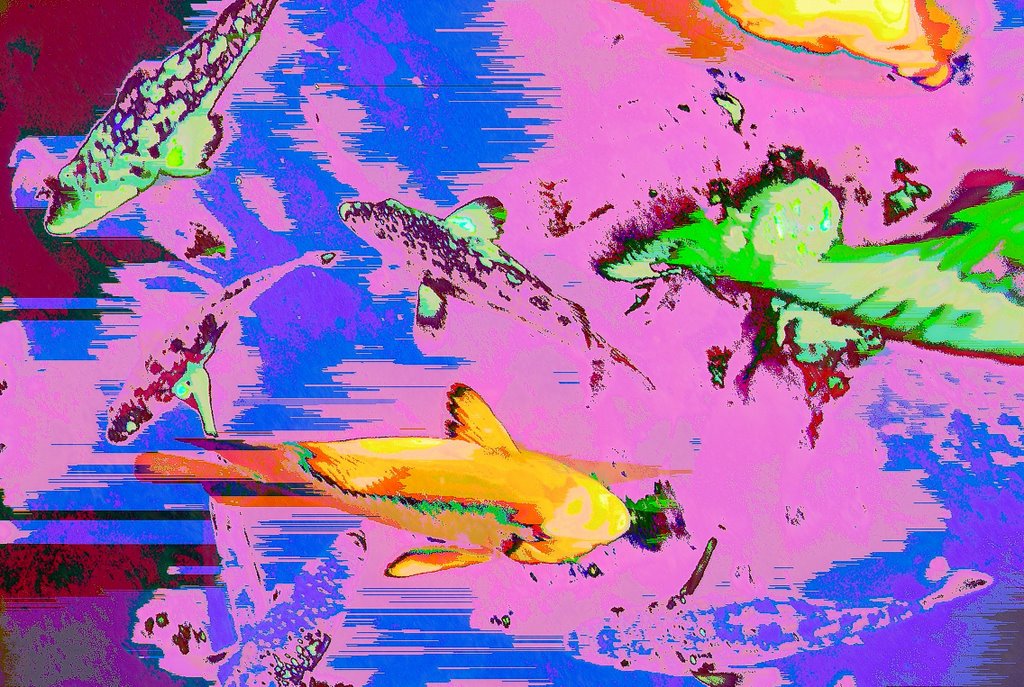
Warhol Bass So.....when my camera decides to go into an unknown mode underwater, this is what I get. This shot came from Lover's Cove near Avalon. Living in protected waters, these Kelp Bass were very comfortable with human interaction, (looking for a handout). Fish in Lovers Cove are quite spoiled. Many people snorkel with packaged food to feed the fish which I find appalling. These fish would actually bite at me. Not sure if they were angry at me for not providing them food or if they were looking to be first in line if I had something available for them.


Monday, July 24, 2006

No Television Needed: Debbie's Mermaid 100G

I recently set up Debbie's new 100 gallon aquarium that she won at the Western Marine Conference in April. The aquarium was donated by Mermaid Aquarium of Fremont California. The eight bulb 36" T5 flourescent lighting illuminates the aquarium beautifully. Night time viewing is provided by the two bulb moonlight system from Fishbowl Innovations. The Moon Controller is a microcontroller based digital dimmer and moon cycle timer. It automatically varies the intensity of the connected moonlights over a 29.5 day period (the lunar month) to mimic the natural progression of the moon.

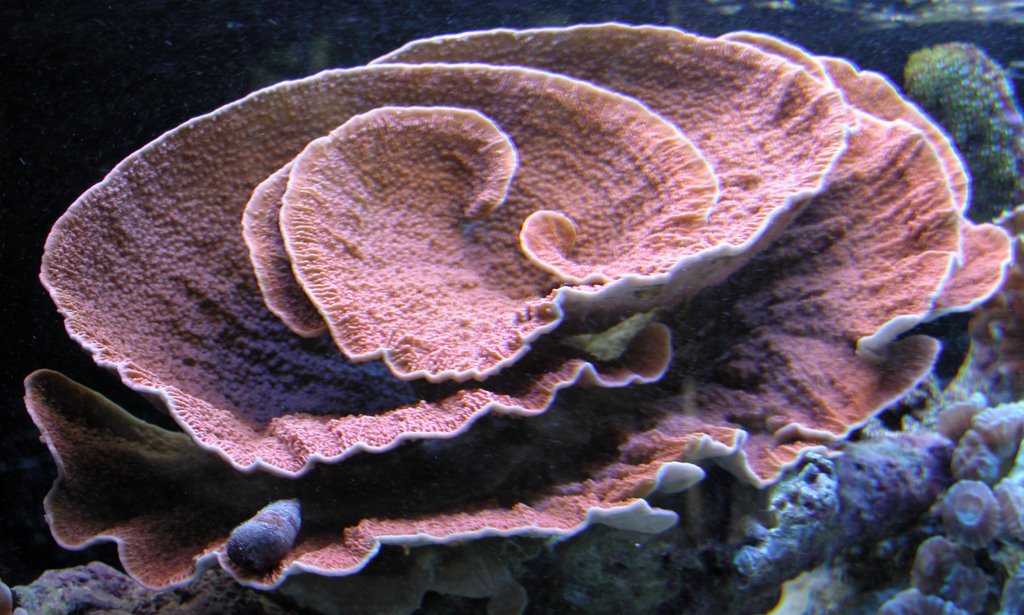
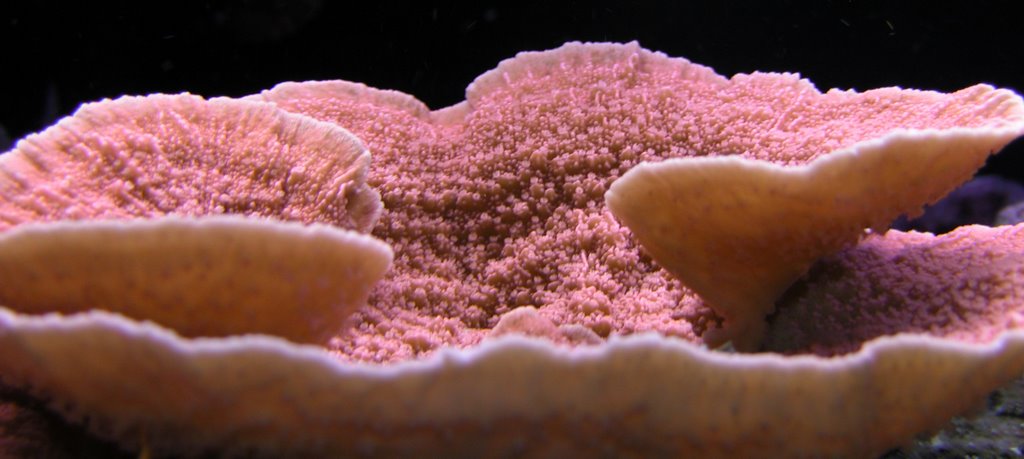
The showpiece of Debbie's aquarium, in my opinion, is the beautiful Montipora Capricornis. The Monti Cap was originated from Tim Plaza, Marine Aquarist Roundtable of Sacramento and has grown from a quarter sized frag. The colony is now over a foot and a half large.

This aquacultured coral is peaceful and can be placed in close proximity to other similar peaceful corals in the reef aquarium. Aquacultured Montiporas are one of the easier to maintain SPS corals and grow rapidly in the established reef aquarium. It requires medium lighting combined with a medium water movement within the aquarium. For continued good health, also requires the addition of calcium, strontium, and other trace elements to the water.

Thursday, July 20, 2006

Spaghetti Worms

The Spaghetti worm is a tube dwelling worm that is usually found burrowed in the sandbed with its numerous tentacles exposed to gather edible organic matter. These worms are very complex animals, and have a body that may be divided into three regions, a head, thorax, and abdomen. The head is for feeding and respiration, the thorax for moving, and the abdomen for the digestion. Although these animals can be found eating large carcasses of a fish or invert, they inevitably came across the dead animal and in no way could it kill a larger animal on their own.

Wednesday, July 05, 2006

Clowning Around

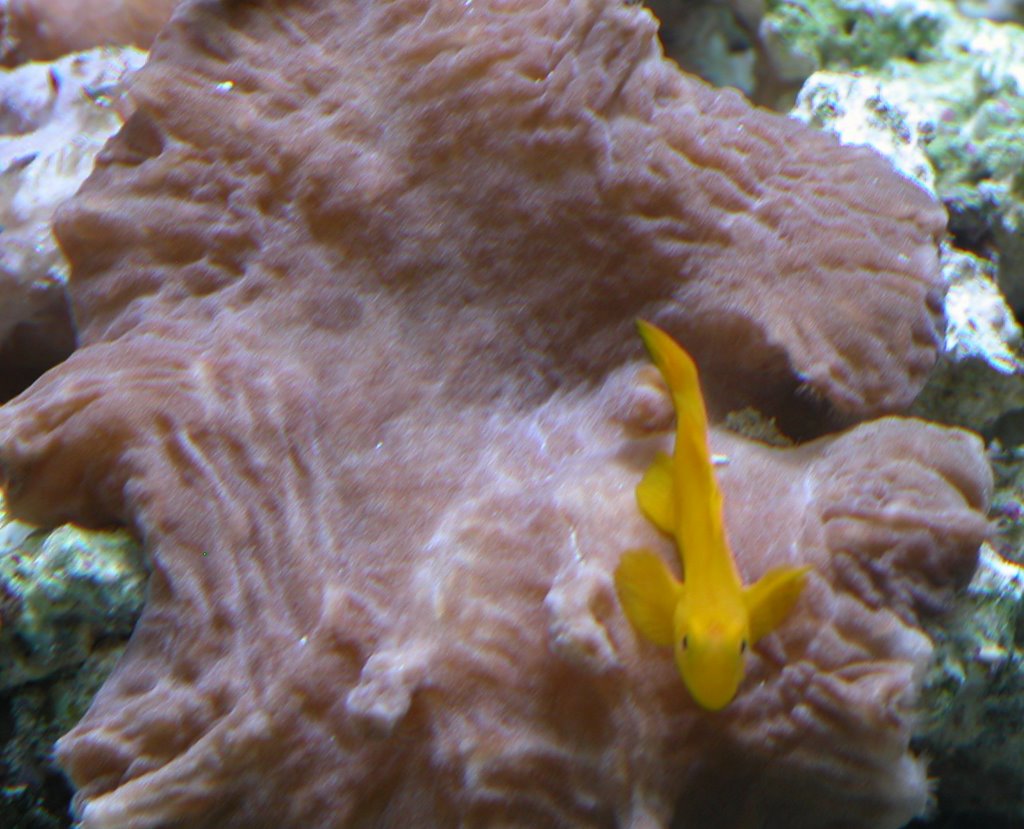
The Yellow Clown Goby, Gobiodon sp. have a difficult time adjusting to captive care, since it is all too often that these fish arrive at our local fish stores emaciated, similarly to the Mandarin Goby. This is most likely due to the stressful transit period, which results in the fish not eating. Being a smaller fish, and having what appears to be a fairly quick metabolism, not many of these fish make it to the hobbyist tank without having been starved to some degree or another. To compound this problem, they regularly require live foods and special attention until accustomed to aquarium life. Frozen/thawed foods can be offered first or the Arcti-Pods from Reef Nutrition, but if they are not accepted, be prepared to offer live food. Although fish of the genus Gobiodon are coral dwellers, usually utilizing the genus Acropora, it is not absolutely necessary that Acropora be present in their tank. In the home aquarium Gobiodon sp. will often co-exist with other stony corals, or even soft corals, lacking more preferable options. In aquariums without sufficient coral growth, it is likely that the Gobiodon sp. will either hide within rockwork, or seek out any other hiding places it can find. Given this type of environment, it will not be comfortable, and most likely will not adapt well to captivity. Due to their obligate coral dwelling nature, they can easily be kept in small or nano reef aquariums.

Wednesday, June 28, 2006

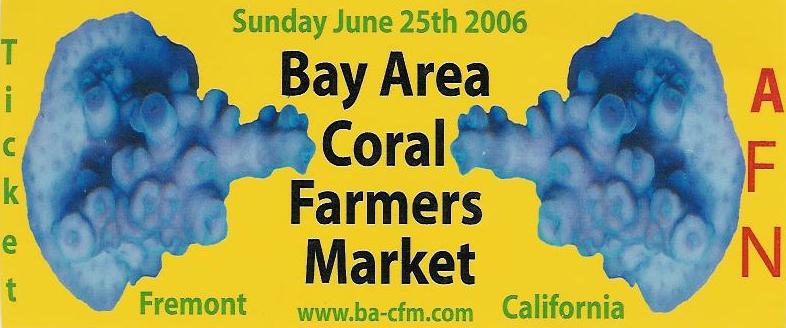
Bay Area Coral Farmers Market

Steve Tyree, Reef Farmers, brought a very successful Southern California event to Northern California last weekend, the Bay Area Coral Farmers Market. These events feature the retail distribution of farmed and cultured corals. Steve is already eying adding a third event to the rotation in 2007. Aquacultured corals are hardier than wild caught specimens because they have already adapted to tank life. Captive reproduction is the only means of sustaining this hobby. On every level from the wholesaler and collector to the local fish store (LFS) owner, to the service industry, to the hobbyist, captive propagated corals must be demanded.

Limited Edition Green Polyped Sunset Coral I purchased this limited edition frag from Steve Tyree and reeffarmers.com mainly due to its striking beauty, but also because of the uncertainty of its specie. Polyps are twice the size of average Montipora, they extend regularly during the day. When heavily stressed the corals living tissue will retract inside the skeleton and it can appear almost completely dead. This coral however will recover from heavy stress quickly and can even encrust quickly. It should eventually become a brilliantly colored staple of stony reefs. Polyp size leads one to suspect the coral to be either a Poritidae, Faviidae or one of the larger polyp sized Montiporas. This coral was originally found by Tong's Tropical Fish of Fountain Valley California. Hugo Zuniga (SNIPERSPS) spotted the coral at the reef shop and convinced Steve Tyree of Reeffarmers and Frank Burr of Tropical Reef Oasis into a trip to Tong's Tropical Fish. The three negotiated a purchase of a small section of this coral from Tong's. The coral was then cut into three even sections. Reeffarmers acquired one of the sections and is now distributing fragments on a limited edition basis. Reef Farmers price is currently $120 per small sized fragment. The monthly limited edition reservation schedule is booked until September 2008. I hope to be able to start fragging this piece by mid 2007 after allowing it to grow to a multiple fragable piece.

Green Birdsnest The Green Birdsnest coral is a beautiful species, originating from O.R.A and now from Ron Johncola of Reef Tec Designs and grows very thin intertwining branches. It's green coloration will grow darker in the aquarium with age. This is a relatively fast growing species, and because of its delicate branches, care should be taken in the placement of the coral in order to protect it from physical damage. The Green Birdsnest coral requires moderate lighting ranging from power compacts, VHO, T-5's up to the more intense metal halides. For continued good health, it will also require the addition of calcium, strontium, and other trace elements to the water. While it does not require additional food to maintain its health in the reef aquarium, it will feed on micro-plankton and foods designed for filter feeding invertebrates.

Sponsors/Vendors Golden Sponsors; Mermaid Aquarium, Reef Nutrition Vendors: reeffarmers.com, atlantisaquarium.net, fragfarmer.com, reefready.net, acoralsource.com, awexotics.com, reeftecdesigns.com, jendub.com, yourreef.com, diamondsinthereef.com, newalameda.com, elousa.com.

Wednesday, June 14, 2006

Casino Conversion

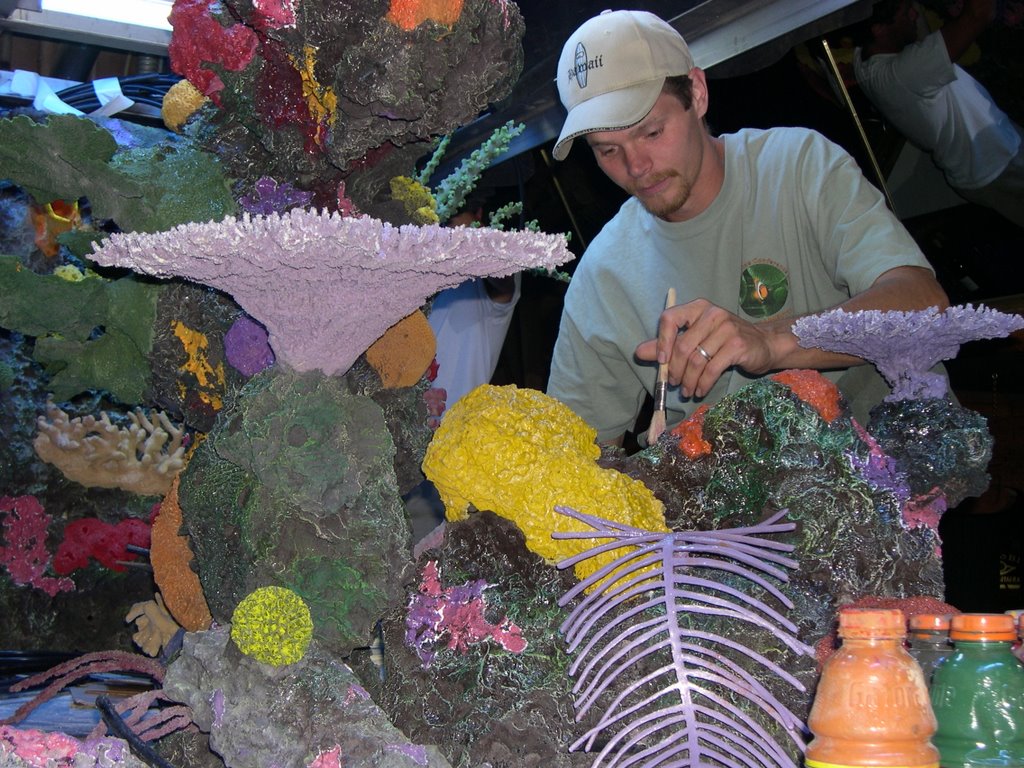
Skyler Allingham of Genesis Systems International cleans a section of the artificial reef at John Ascuaga's Nugget, Sparks Nevada, Trader Dicks 6,000 gallon aquarium in preparation to hand paint coralline algae on the rockwork. I recommended GSI to Dennis Hegemann, Chief Engineer, to create the structures that wrap Interstate 80's three freeway supports that run straight through the center of the aquarium. The aquarium is undergoing a complete overhaul with glass replacement, the new artificial reef and filtration. Look for the aquarium to be filled and stocked in late July.

Wednesday, May 17, 2006

Deep Sand Beds and Refugiums

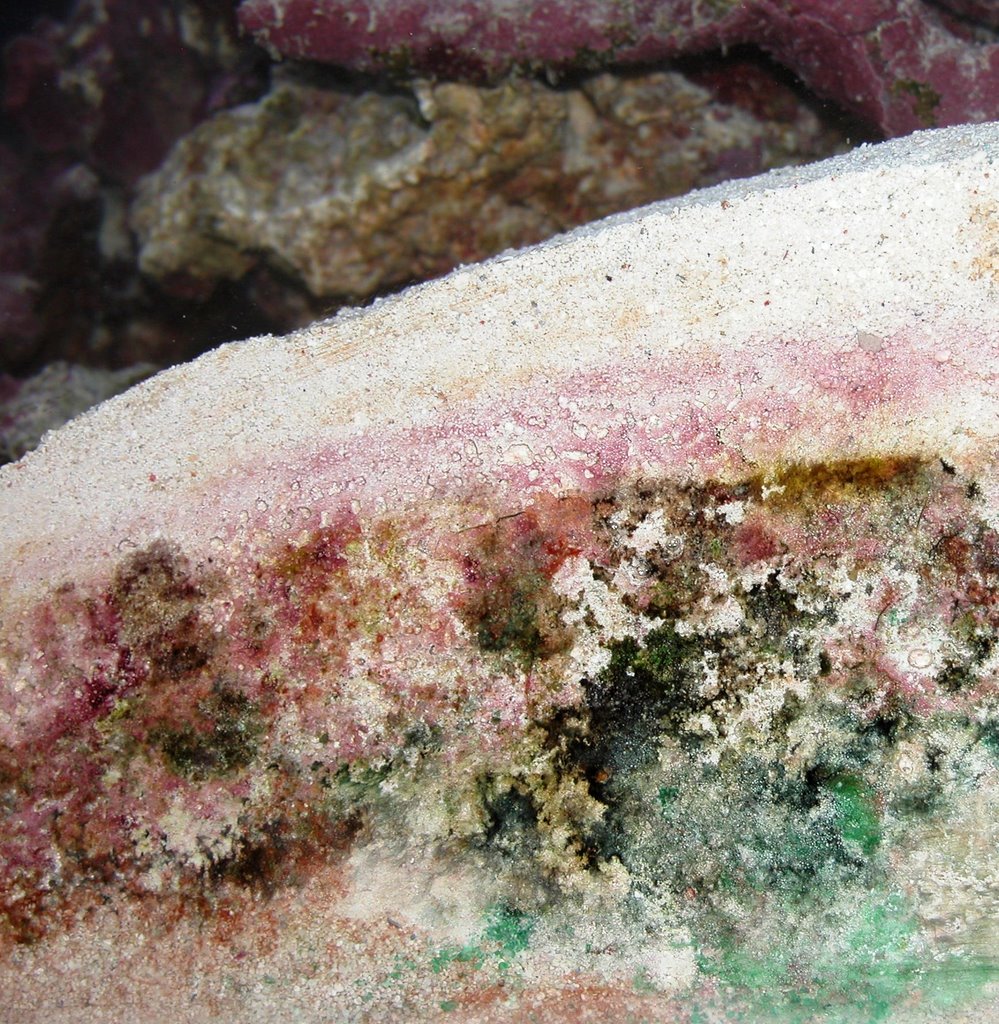
Hiro Sushi's Six Inch Sand Bed. There has been a lot of discussions lately on the bulletin boards I frequent about whether aquarium's should be set up with a deep sand bed, shallow bed or bare bottom. I have always been a huge advocate of using as deep a sand bed as aesthetically possible, using Carib Sea AragaMax sugar sized sand. In addition to a deep sand bed, I also use a refugium, live rock, high flow in the water column, a protein skimmer and calcium reactor in reef tanks. This equipment and the proper stocking of animals make a fool proof system.

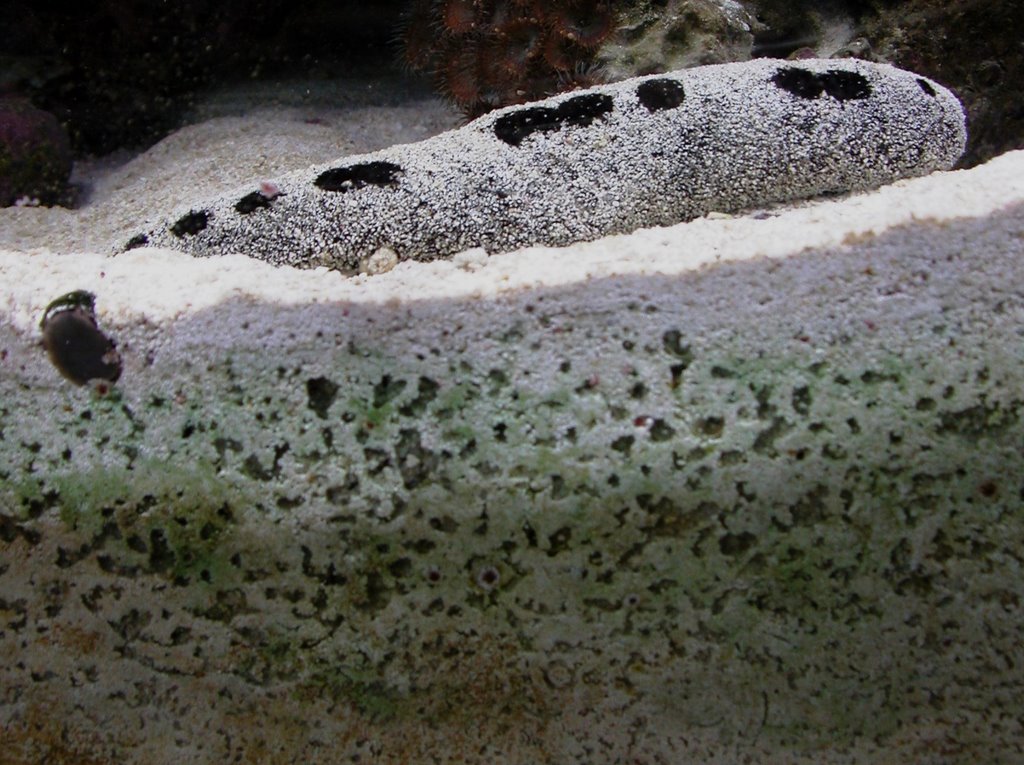
Java Sushi's Five Inch Sand Bed. Installation of a deep sand bed is one of the least expensive type of filtration, and requires minimal maintenance when paired with the proper animals to do the work. The Pacific Black Sea Cucumber is an excellent sand sifting animal that does not destroy a sand bed of life. In addition, the Orange Diamond Goby, large Nassarius Sand Snails and burrowing bristle and spaghetti worms help remove sediment. They are actively consuming diatoms and promotes oxygen penetration that allows them to live in the bed.

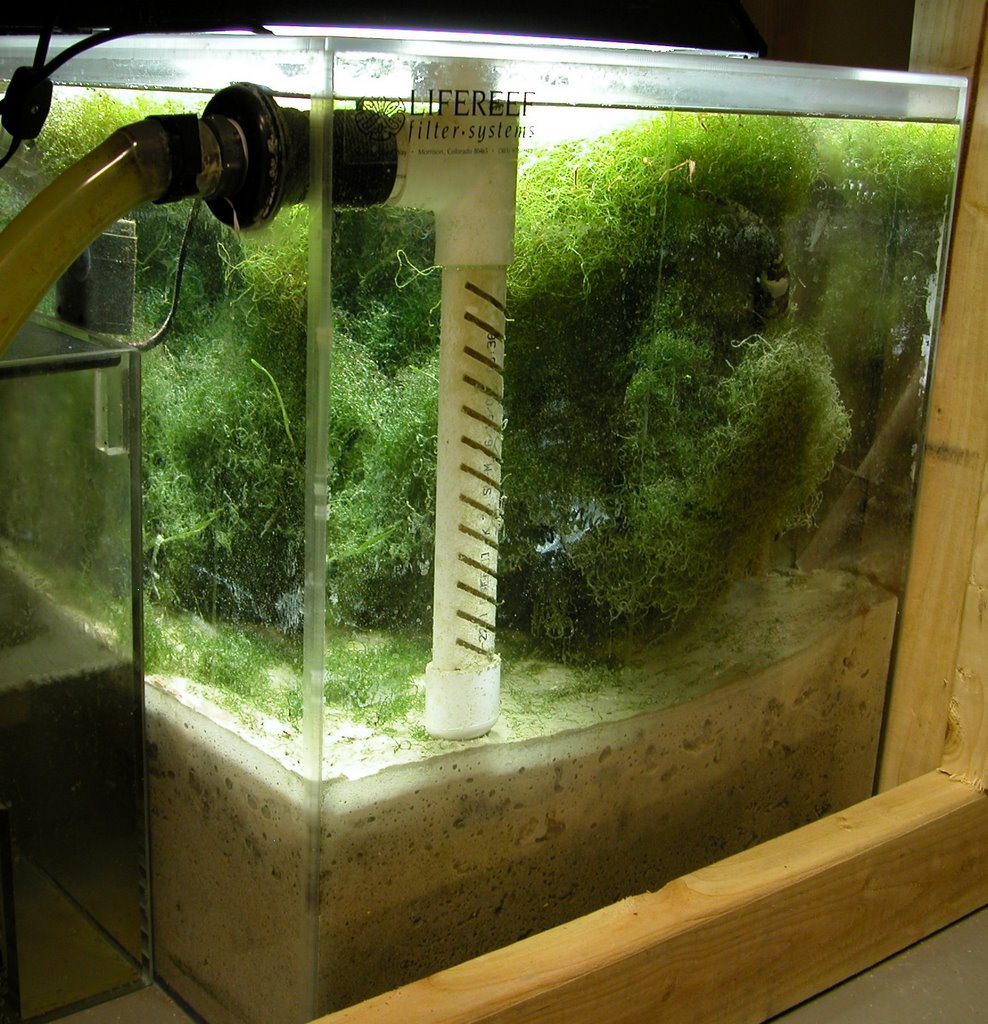
LifeReef Refugium. A deep sand bed occupies a large amount of viewing space in an aquarium. I prefer to use a minimum of a three inch sand bed in an aquarium and then a 6-8 inch sand bed in an auxiliary refugium. This LifeReef 40 gallon refugium with chaetomorpha algae has an 8 inch sand bed that keeps nitrates undetectable in a 180 gallon heavily stocked reef tank. I also employ the use of Leng Sy's EcoSystem Refugiums in some of the smaller systems I maintain.

Wednesday, May 03, 2006

My Commute

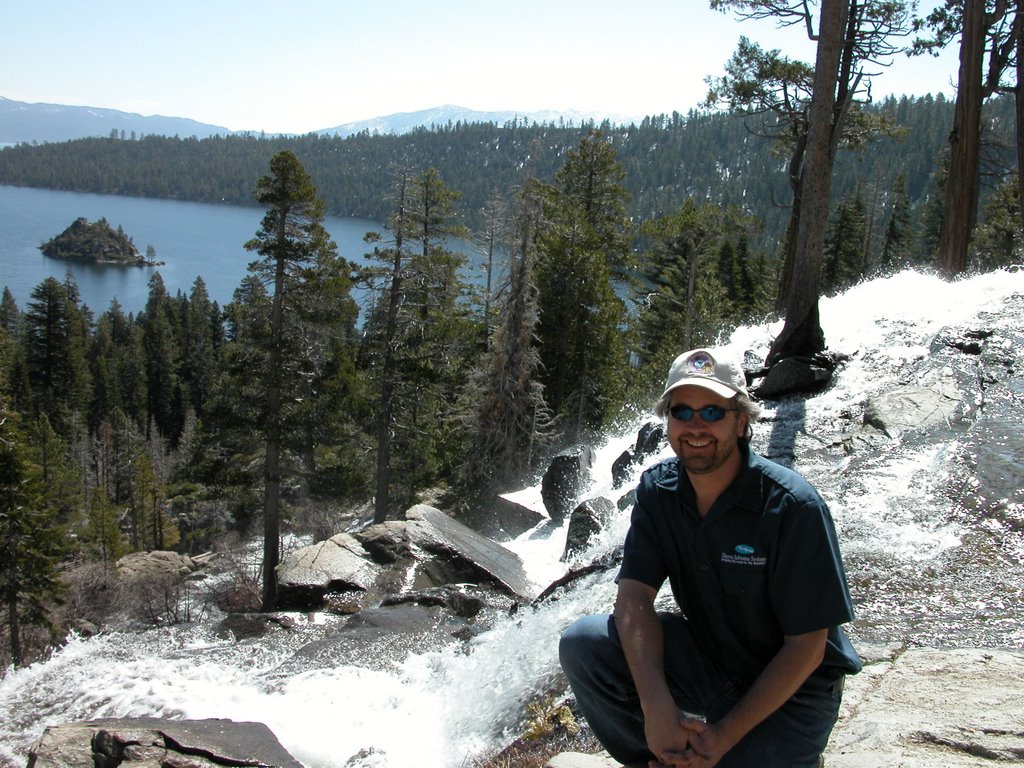
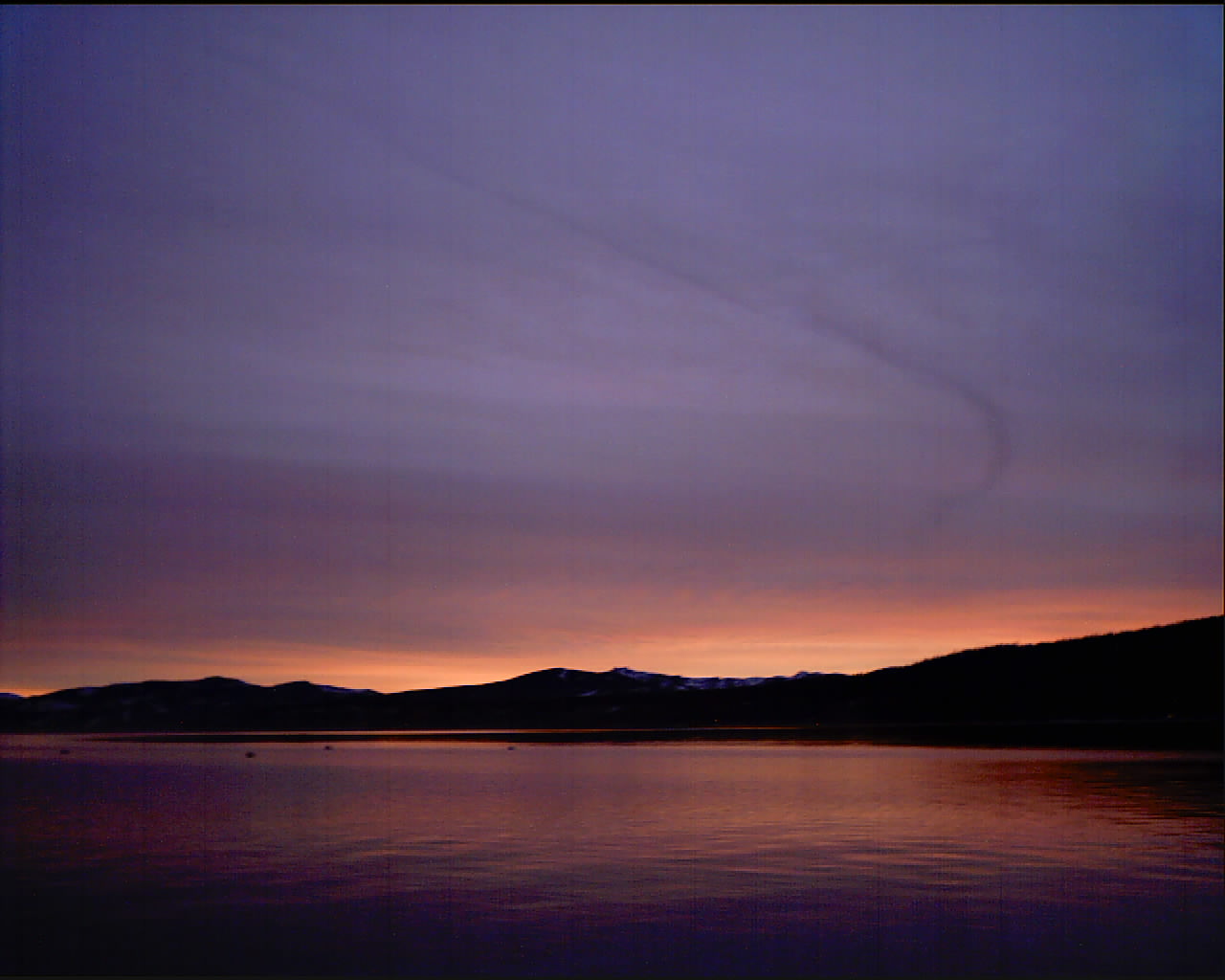
I feel pretty lucky. Some days I laugh out loud when I think of city commuters. Many of my clients are 30-40 minutes away from my shop in Carnelian Bay and I am quite fortunate to see a lot of beautiful scenery along the way. Whether it's a sunset view from the east shore of Lake Tahoe, a blinding snow storm going over Mt. Rose Highway to Reno or the American Bald Eagle I recently saw hovering over the old rail-yard in Truckee, I always have a camera with me to capture the moment. The photo above is of Eagle Falls at Emerald Bay. I recently finished setting up three new aquariums in offices in South Lake Tahoe and Highway 89 just reopened after being closed most of the winter. With this year's snowpack, the falls are flowing at the highest rate I've ever seen. Today's gas prices are getting out of hand ($3.45 in Kings Beach today for regular unleaded), but with views like these, driving is priceless.

Monday, April 24, 2006

WMC Wrap Up

Speaker Anthony Calfo gave a good review of the WMC in this Reef Central post: "Kudos to the committee and the attendees that made this conference truly a success! As one that has attended and helped to plan my share of such, I can honestly say it was a very fine job for your first (re-annual ) big event. It was a yeoman's chore that the committee pulled to coordinate a 3-day event with so many participants... and it appeared to run so very smoothly.

I am certain if/when you hold WMC again you will be rewarded with even greater success.

The other regional clubs/folks especially that missed this event truly missed a good time and really should not miss the next time around. It is so important that we show support for each other (sister societies) in the pursuit of our information gathering/sharing. The late night chat sessions with wise and wiley folks like that inimitable Bob Fenner are just icing on the cake."

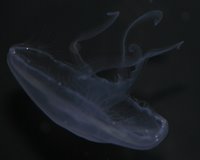
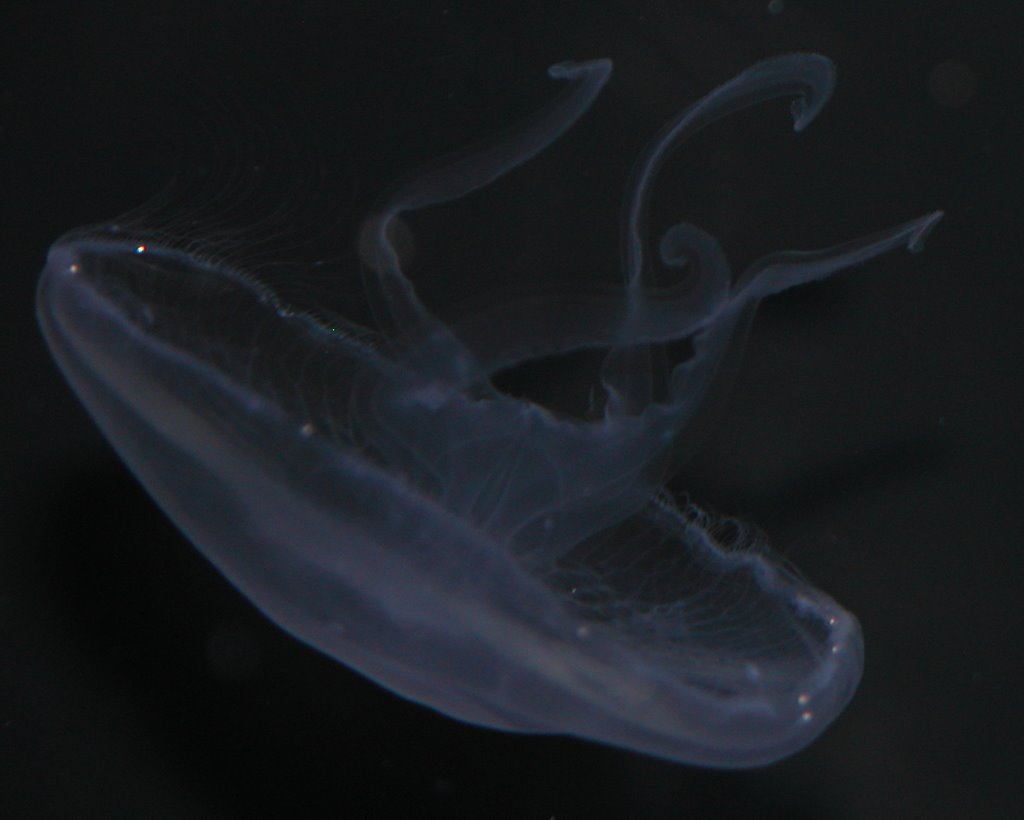
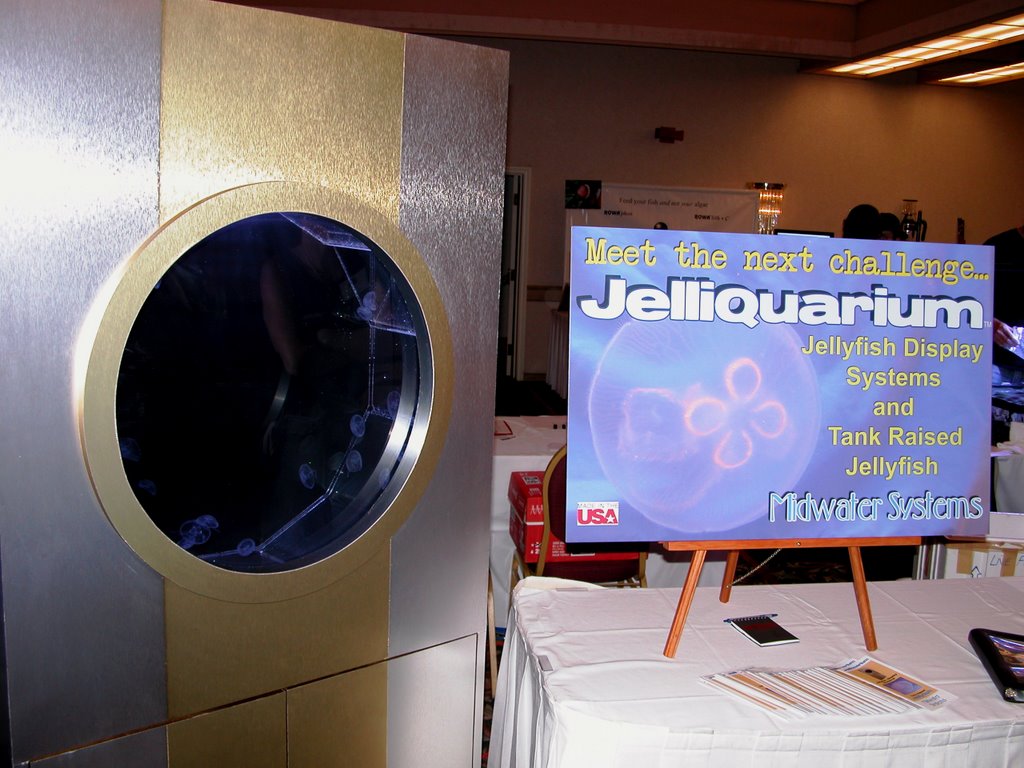
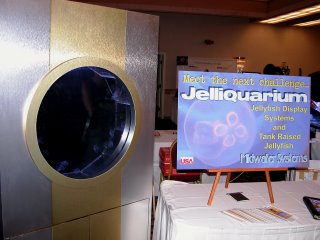
Jelliquarium Jim Stime of Thousand Oaks, CA has found a creative niche in today's aquarium-keeping hobby with the introduction of his Jellyfish aquariums.The "midwater zone", the area of the ocean that no longer uses daylight to photosynthesize, contains the majority of the ocean's life and is where some of the most interesting animal life can be found. Jellyfish, which mainly live in this zone, are made up of 99% water and are found all over the world, in every ocean and even in freshwater. Jellyfish collection is a difficult task and permits are limited. Jelliquarium not only sells the systems that are required to keep these animals alive, but also provide the tank raised animal. The Jelliquarium, also known as a plankton Kreisel, is uniquely designed. Water flow is introduced by a method called laminar flow. This creates a gentle flow that keeps the jellyfish in suspension. This flat stream of water acts as a boundary against the edges of the tank and creates a water flow that helps to separate debris in a manner as to not draw the jellies into the filter system and to maintain the gelatinous organisms in suspension.
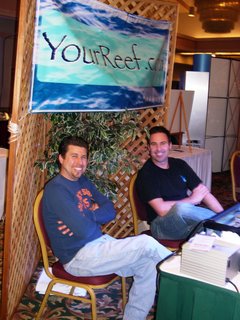
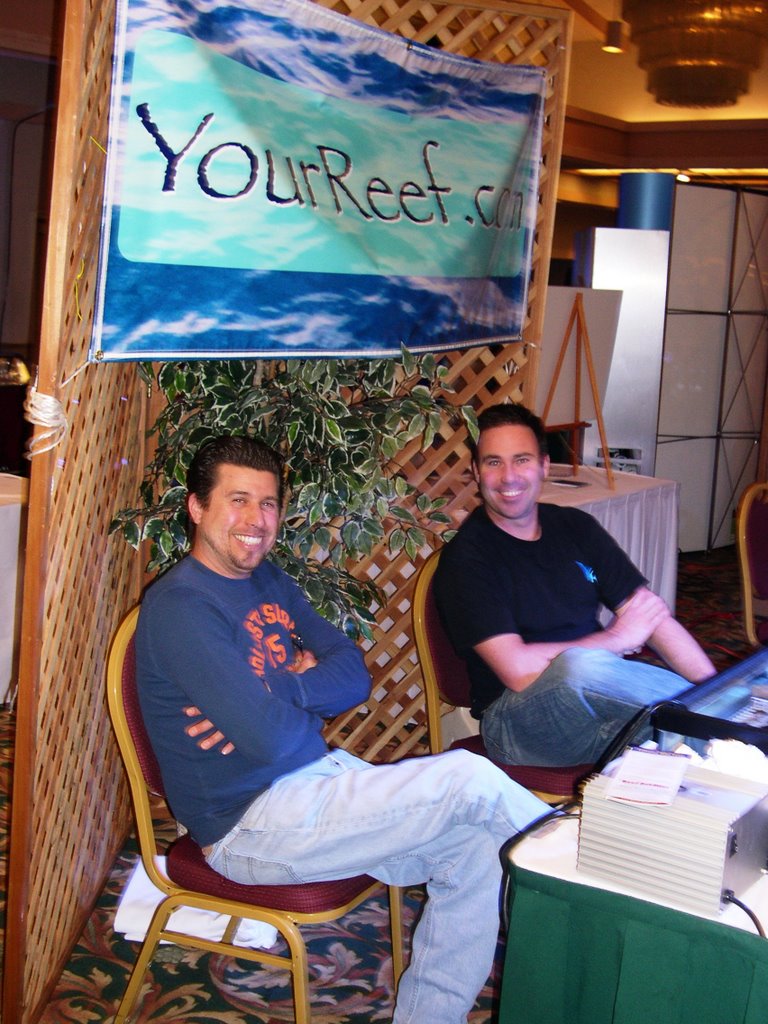
FragFarmer.com and YourReef.com Eric Caamano, left, of Frag Farmer dot com, (909)931-7977, made the trip from Southern California to take a break from the day to day business and relax with friends and colleagues. After years of working out of his home, John Daakan, right, of Roseville, recently opened Your Reef, (916)786-3474, his retail store to supplement his on line sales. These gentlemen undoubtedly sell some of the best corals in the United States and also donated a good number to the WMC raffle.
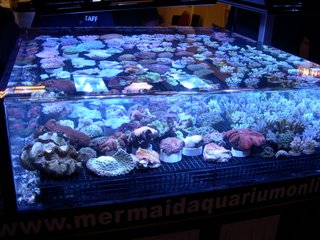
Max of Mermaid Aquarium from Fremont set up a very cool seamless aquarium full of Tonga SPS colonies, clams and LPS corals. Mermaid also donated the grand prize to the WMC raffle, a $3000 retail value 100 gallon aquarium with a cherry stand and canopy. My client Debbie from Truckee was the fortunate winner!
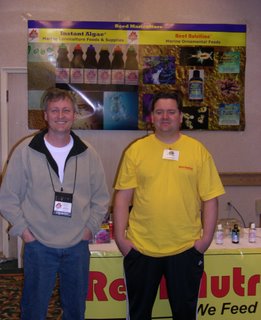
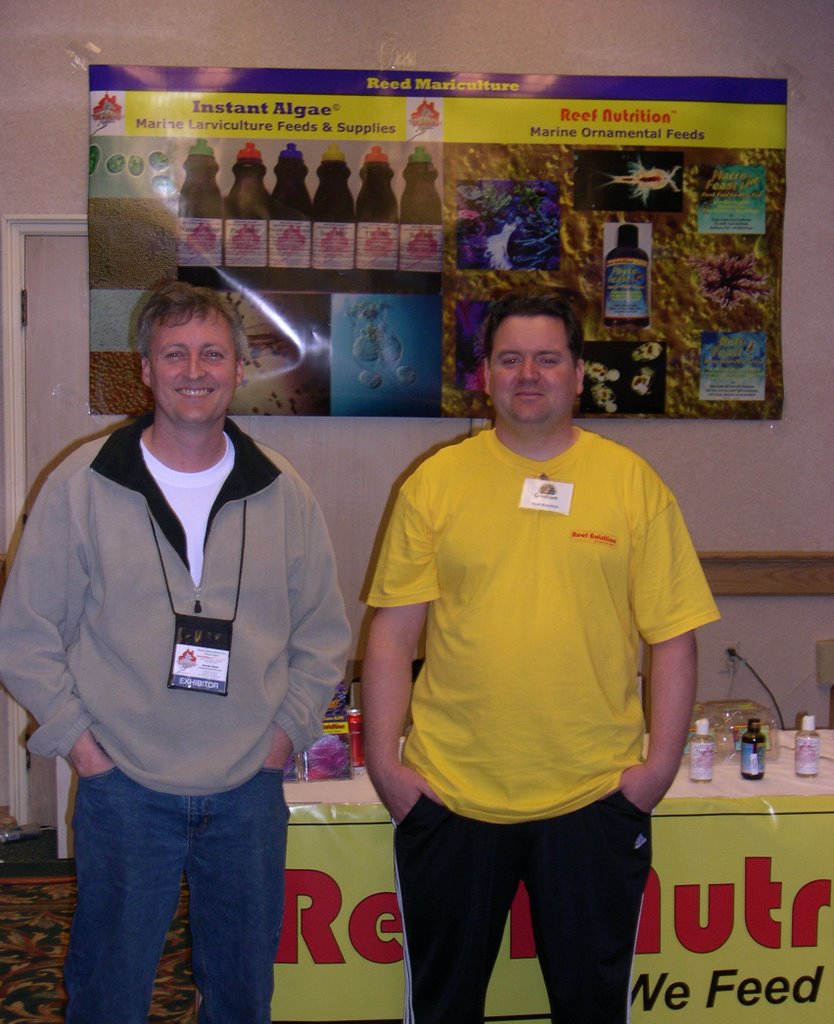
Reef Nutrition The talk around Randy, left, and Gresham's booth was all about their new product, so new it doesn't have a name and it has not yet been packaged. The product is super cool little red algae puffs for tang feeding. Whether they label it Tangy Treats, Tang Feast, or Tribbles, it is a hot product that will keep your herbivores fat and happy.
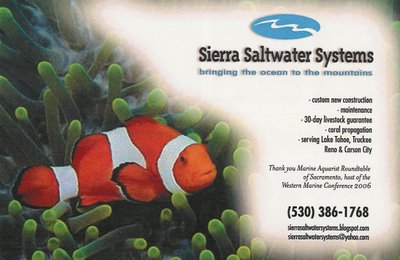
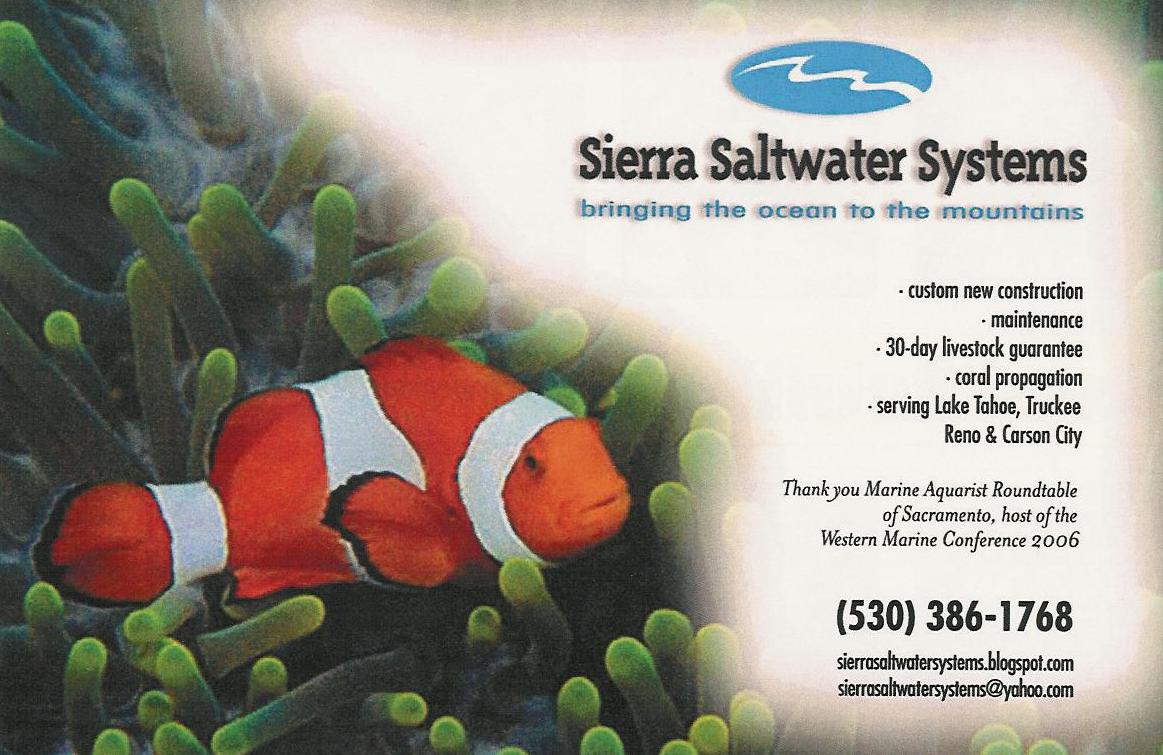
A copy of Sierra Saltwater System's ad created by Shelley Fallon, Fallon Multi Media, Kings Beach, (530)546-9393, that ran the in conference program.
Additional vendors attending the conference were CPR, Sunlight Supply, Coral Reef EcoSystems, Piscine Energetics, Reef Frontiers, Coral Magazine, Fishbowl Innovations, Tropical Reef Oasis, Walt Smith, Liquid Life, Reefs.org, Pacific Garden Supply, Catalina Aquarium, ROWA USA, SeaChem Labs, CaribSea, and DT's Plankton Farms.

Donators included, Clams Direct, Dainichi, Innovative Lighting Solutions, Island Marine Tropicals, Ocean Nutrition and TruVu.